

This case study is hypothetical and for educational purposes only. Scenarios, borrower profiles, loan terms, interest rates, and outcomes are illustrative examples and do not represent current offers or guaranteed terms.
For specific details including down payment requirements, closing cost estimates, interest rate details, closing cost breakdowns, payment calculations, cash-to-close estimates, or an official Loan Estimate, it is highly recommended you schedule a meeting with one of our licensed mortgage advisors.
Learn more:
Actual loan terms vary by credit profile, property, occupancy, location, market conditions, and lender guidelines. For current options tailored to you, schedule a consultation or apply online.
Ready to explore your options? Schedule a call with a loan advisor.
Jennifer M., a 32-year-old registered nurse at a busy Jacksonville hospital, had always dreamed of building her own home rather than buying something someone else designed. After years of working rotating shifts in the ICU, she had saved modest funds and built solid credit. When her parents gifted her a beautiful parcel of cleared land in St. Johns County—inheritance from her grandmother—Jennifer saw her opportunity to finally build the custom home she’d envisioned.
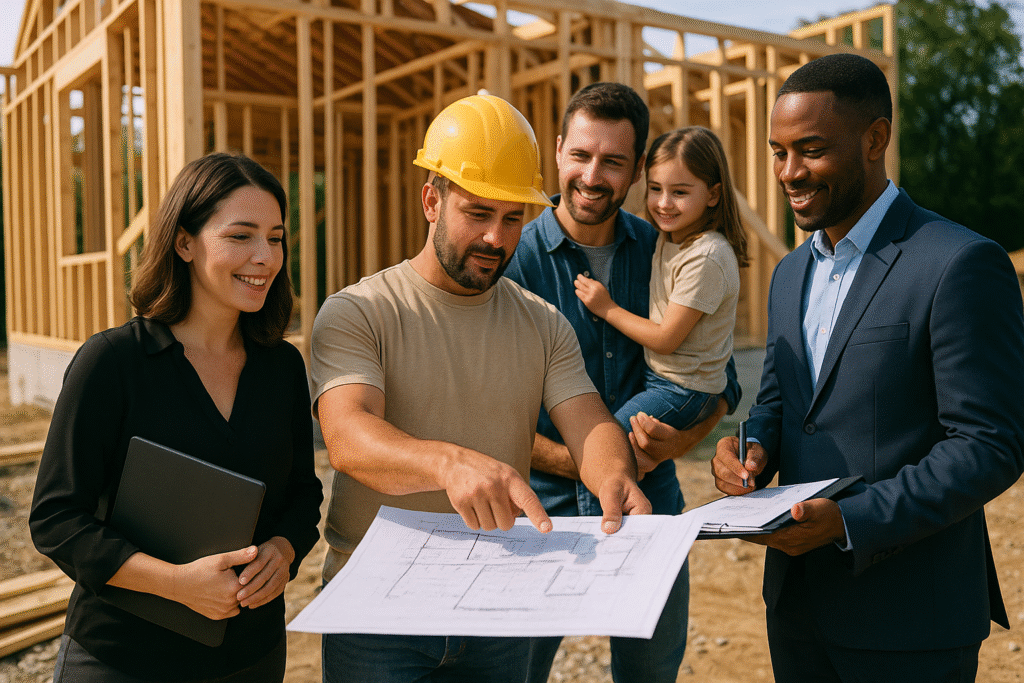
The land was paid off and ready for construction in a desirable area with excellent schools and growing community amenities. Jennifer had clear plans: a three-bedroom, two-bathroom home with an open floor plan, energy-efficient features, and a covered porch for enjoying Florida evenings. She consulted with builders, reviewed floor plans, and refined her vision. Everything was falling into place—until she started exploring financing options.
“I had the land, the plans, and the savings,” Jennifer explained. “I thought getting a construction loan would be straightforward since I owned the property outright and had stable employment. I was shocked when I discovered how complicated and expensive traditional construction financing actually is.”
Jennifer’s vision extended beyond just building this one home. She wanted to create a place where she could raise a family, build equity through strategic homeownership, and eventually leverage that equity to help her children with their own homeownership journeys or perhaps purchase a small rental property. This wasn’t just about having a house—it was about building generational wealth and creating a legacy for her family through smart real estate decisions.
Facing similar challenges? Schedule a call to explore your options.
Jennifer contacted three traditional lenders confident that her stable nursing income, excellent credit, debt-free land, and solid savings would make construction financing straightforward. Instead, she encountered obstacles she never anticipated.
Traditional construction loans typically use a two-close structure: first a short-term construction loan with a variable rate and interest-only payments during the building phase, followed by a permanent mortgage once construction completes. This means two separate closings, two sets of closing costs, two qualification processes, and potential rate changes between the construction phase and the permanent mortgage.
The traditional lenders explained Jennifer would need to close on a construction loan first, make interest-only payments during the building phase, and then “convert” to a permanent mortgage after construction completed—paying closing costs twice. Additionally, traditional construction loans required larger down payments and substantial cash reserves beyond her current savings.
“The numbers were overwhelming,” Jennifer said. “The construction loan required a down payment significantly larger than I’d saved, plus enough reserves to cover months of interest-only payments during construction, plus closing costs—and then I’d have to pay closing costs again when converting to the permanent mortgage. I’d need almost double what I had saved just to get started, and I’d be making payments during construction even though I couldn’t live in the house yet.”
Traditional lenders also warned Jennifer that if interest rates rose between the construction closing and the permanent mortgage closing months later, her permanent mortgage rate could be substantially higher than originally projected. She’d be locked into whatever rates were available when construction finished, with no control over market conditions. This uncertainty added stress to an already expensive process.
The construction lenders explained that because building timelines can extend unpredictably due to weather, supply chain delays, or contractor issues, they required substantial cash reserves to ensure borrowers could continue making interest-only payments even if construction took longer than planned. For Jennifer, who had saved appropriately but modestly, these reserve requirements were simply beyond her means.
“I felt defeated,” Jennifer admitted. “I had this beautiful land, solid income, great credit, and a clear vision—but traditional construction loans were designed for people with massive savings and high incomes. I started wondering if I’d ever be able to build, or if I’d have to sell the land and just buy an existing home like everyone else.”
Experiencing similar rejection? Schedule a call to discuss alternative qualification methods.
Discouraged but not ready to give up, Jennifer mentioned her financing struggles to a builder she’d consulted with during her planning phase. The builder immediately suggested she research FHA construction loans—specifically, the FHA construction-to-permanent loan program designed for first-time builders with modest budgets.
Intrigued, Jennifer discovered that FHA construction loans work fundamentally differently than conventional construction financing. The program uses a single-close structure: one loan, one closing, one set of closing costs, and one locked interest rate that applies from construction start through the permanent mortgage phase. No conversion, no second closing, no rate uncertainty.
Jennifer learned that FHA construction loans require significantly lower down payments than conventional construction financing—comparable to standard FHA purchase loans. The program also accepts lower credit scores and more modest reserve requirements, making custom home building accessible to buyers who traditional lenders turn away.
“When I read about the single-close structure, I couldn’t believe it,” Jennifer said. “One loan, one closing, one locked rate—that solved every problem I’d faced with traditional lenders. And the down payment requirement was something I could actually afford instead of needing double what I’d saved.”
Jennifer scheduled a consultation with an FHA construction lender who explained how the program works particularly well for borrowers who already own their building site. Since Jennifer’s land was paid off and properly deeded, its value could be applied toward her equity position, reducing the cash she needed to bring to closing.
The FHA construction lender reviewed Jennifer’s employment history, income, credit, building plans, and contractor selection. He explained the draw schedule process, inspection requirements, and timeline expectations. For the first time since starting her construction journey, Jennifer felt confident that building her dream home was genuinely achievable on her modest nursing income and realistic savings.
Jennifer worked closely with her FHA construction lender to navigate the program’s specific requirements for new construction financing. The FHA construction loan process required more documentation than a standard purchase but significantly less complexity than traditional construction-to-permanent loans.
Jennifer’s FHA construction lender guided her through assembling the required documentation:
Personal financial documentation:
Property and construction documentation:
Jennifer’s approval timeline was comparable to traditional construction loans but with significantly simpler documentation requirements:
The FHA construction loan approval process:
Total timeline from application to closing: Comparable to traditional construction loans but with single-close simplicity
Jennifer’s FHA construction lender explained the construction fund disbursement process in detail. Rather than receiving all construction funds at closing, money would be held by the lender and released to her contractor as work progressed through specific phases and passed required inspections.
The FHA construction draw process:
“The draw schedule gave me control and protection,” Jennifer explained. “My contractor was paid as work was completed and inspected, so there was accountability at every phase. I wasn’t worried about handing over funds upfront and hoping for the best—the system protected both of us.”
Unlike traditional construction loans requiring interest-only payments during the building phase, Jennifer’s FHA construction loan allowed her to continue renting her apartment affordably while construction progressed. Some FHA construction loan programs offer flexible payment options during construction, helping first-time builders manage cash flow during the building period.
Ready to purchase? Submit a purchase inquiry to discuss your scenario.
Jennifer closed on her FHA construction loan with a single closing, locked in her interest rate for both the construction phase and permanent mortgage, and watched her custom home rise from the ground over the following months. The construction process proceeded smoothly with her qualified contractor managing all phases while the FHA lender coordinated inspections and draw payments.
Final loan outcome:
Traditional two-close construction financing vs. FHA construction loan:
Traditional path Jennifer couldn’t pursue:
FHA construction loan path Jennifer successfully completed:
“Without the FHA construction loan, I would have had to sell my grandmother’s land and buy an existing home,” Jennifer said. “Traditional construction financing was simply out of reach financially. The FHA program made it possible for someone like me—a working nurse with modest savings—to build a custom home exactly the way I wanted it, on land that’s been in my family for generations.”
Jennifer now lives in her beautiful custom-built home in St. Johns County. The home she built for below-market construction costs is worth substantially more than her total investment—creating significant instant equity. She’s building generational wealth through strategic homeownership, living in a space designed exactly for her needs, and already planning her financial future.
“This home is the foundation of my wealth-building plan,” Jennifer explained. “I built significant equity through the construction process since the as-completed value exceeds what I invested. My goal is to live here while building more equity, and eventually when I’m ready for my next life phase, I can either upgrade to a larger home or keep this as a rental property and let tenants pay the mortgage while I move to property #2.”
When Jennifer is ready for her next strategic real estate move, she plans to leverage the equity she’s built by using a HELOC or Home Equity Loan. This approach will allow her to access capital for future investments or her next home purchase without refinancing and losing her current locked-in FHA rate—a smart strategy for building wealth while preserving favorable financing.
Ready to get started? Get approved or schedule a call to discuss your situation.
While Jennifer used an FHA construction loan to build new construction on family land, FHA financing works for multiple scenarios:
Have questions about qualifying with FHA construction financing? Schedule a call with a loan advisor today.
If an FHA construction loan isn’t the perfect fit, consider these alternatives:
Explore all loan programs to find your best option.
Learn more about this loan program:
Similar success stories:
External authoritative resources:
Ready to get started?
Need local expertise? Get introduced to trusted partners including loan officers, builders, and contractors in your area.
Buying a home soon? Complete our short form and we’ll connect you with the best loan options for your target property and financial situation—fast.
Skip the guesswork. Take our quick Discovery Quiz to uncover your top financial priorities, so we can guide you toward the wealth-building strategies that fit your life.


Get the latest insights and mortgage case studies in your inbox.