

You earned the Doctor of Veterinary Medicine degree—whether designated VMD (Veterinariae Medicinae Doctoris, used by the University of Pennsylvania) or DVM (Doctor of Veterinary Medicine, used by all other AVMA-accredited institutions)—through four years of undergraduate prerequisites followed by four years of veterinary medical school combining anatomy, physiology, pathology, pharmacology, surgery, clinical rotations, and species-specific medicine.
Your career spans companion animal practice, equine medicine, large animal/food animal practice, exotic and zoo medicine, emergency and critical care, veterinary specialty practice, research, military service, public health, and industry—generating $95,000-200,000+ annually depending on setting, specialty, and ownership status.
But veterinarians face the most severe proportional debt burden of any qualifying medical profession:
The debt-to-income ratio reality:
At 1.70x, veterinarians carry the highest proportional student loan debt relative to income of any profession qualifying for the physician mortgage program. Conventional underwriting applying 0.5-1% of balance as imputed monthly payment creates a disproportionate barrier.
The Non-Conforming Loan for Medical Professionals offered through Stairway Mortgage, Division of NEXA Mortgage LLC, addresses this directly. The program provides up to 100% financing, no PMI, loan amounts to $2 million, manual underwriting evaluating veterinary career stability and practice ownership trajectory, flexible DTI up to 50%, and terms aligned with veterinary career timelines.
Use our Conventional Loan Calculator to see what a standard mortgage would cost—then understand why the VMD mortgage eliminates PMI and down payment barriers.
Key Details About the VMD/DVM Mortgage Program:
Ready to explore your veterinarian mortgage options? Schedule a call with a loan advisor or take our Discovery Quiz to see which programs match your profile.

A VMD/DVM mortgage loan is the same specialized non-conforming mortgage available to MD physicians, DO physicians, dentists, and pharmacists—extended with identical terms to holders of the Doctor of Veterinary Medicine degree. Both the VMD (University of Pennsylvania designation) and DVM (all other AVMA-accredited schools) qualify identically.
Unlike conventional loans requiring 5-20% down with PMI below 80% LTV, or FHA loans carrying lifetime mortgage insurance, the veterinarian mortgage eliminates both barriers.
Why veterinary income requires specialized underwriting:
Veterinarians earn through structures that confuse conventional systems: base salary plus production percentage (typically 18-25% of collections), emergency and after-hours supplements, relief/locum income from multiple clinics, practice ownership draws varying with seasonal patient volume, and mixed W-2/1099 income from combining employment with relief work. Manual underwriting evaluates these components holistically.
Explore the Buy a House Journey for step-by-step guidance, or compare all options across our loan programs.
Professional Credentials:
Qualifying designations (at least one borrower must hold one):
Career stage eligibility:
Co-borrower provisions:
Property and Transactions:
For investment properties: DSCR Loan | Calculator. For non-standard properties: Portfolio Loan. Estimate returns: Rental Property Calculator.
Income Documentation by Practice Type:
Associate veterinarian (W-2): Base salary plus production bonuses documented through W-2 and employment agreement. Two-year average of total compensation including production percentage.
Practice owner (self-employed): Two years tax returns. Hospital revenue and owner compensation through manual underwriting. Alternatives when tax deductions reduce qualifying income: Bank Statement Loan | Calculator and P&L Loan | Calculator.
Relief/locum veterinarian: Two years 1099/W-2 history documenting multi-clinic income. See 1099 Loan | Calculator.
Mixed W-2 plus 1099: Veterinarians combining associate employment with relief work. Manual underwriting aggregates both income streams.
Credit and Financial Standards:
Veterinary practice acquisition creates the same three-investment challenge that dental surgeons face—but at different scale and with distinct financial dynamics shaped by veterinary economics.
The veterinary three-investment reality:
Educational debt: $160,000-220,000
Practice acquisition: $200,000-1,200,000+
Equipment and technology: $100,000-300,000
How practice ownership timing intersects with home purchase:
Pre-ownership phase (associate, years 1-5): Minimal practice debt. Best window for home purchase—only educational debt affects DTI. Production income may be ramping.
Acquisition phase (years 3-7): Practice purchase coincides with peak DTI pressure. Student loans plus practice loans plus equipment creates combined obligation. Manual underwriting evaluates practice revenue against debt.
Established phase (years 7+): Student loans reducing. Equipment loans maturing. Practice equity building. Strongest qualification window for home upgrade.
Alternative documentation for practice-owning veterinarians:
Bank Statement Loan captures hospital deposits when tax deductions reduce reported income. Calculate: Bank Statement Loan Calculator.
P&L Loan uses CPA-prepared statements reflecting actual cash flow. Calculate: P&L Loan Calculator.
Asset Based Loan for veterinarians with significant investment portfolios or practice equity. Calculate: Asset-Based Loan Calculator.
For veterinary clinic construction or commercial property: Blackburn Business Capital provides commercial lending solutions. For residential custom builds: Construction Loan | Calculator.

Veterinarians are more likely than any other qualifying medical profession to purchase homes in rural or semi-rural areas. Large animal practitioners, mixed-practice veterinarians, equine veterinarians, and food animal veterinarians frequently require residential property with acreage, outbuildings, or proximity to agricultural land.
What qualifies under the physician mortgage:
The physician mortgage covers 1-unit primary residences including single-family homes in rural settings. The property must be residential in character—a house on 5 acres with residential zoning qualifies. A working farm with attached veterinary clinic does not qualify under this specific program.
Key rural property considerations:
When the physician mortgage doesn’t fit rural property needs:
Properties with agricultural zoning, working farm income, or commercial veterinary facilities may not qualify. For these situations:
USDA Loan provides zero-down financing in eligible rural areas with no geographic restrictions on agricultural character. Calculate: USDA Loan Calculator.
VA Loan for military-connected veterinarians offers zero-down with flexible property guidelines. Calculate: VA Loan Calculator.
Portfolio Loan finances non-standard properties that don’t fit conventional guidelines.
Jumbo Loan for high-value rural estates. Calculate: Jumbo Loan Calculator.
Use Private Home Search to explore rural properties in your target area. Get a Home Value Report on any property you’re considering.
Scenario: 27-year-old DVM joining companion animal practice:
Solution: Employment agreement documents compensation. IBR at $280 for DTI (not $1,950 under conventional rules). $0 down critical on $105,000 salary. No PMI saves $175/month. Compare: FHA Loan Calculator (3.5% down = $9,275 + lifetime MIP) vs physician mortgage ($0 down, $0 PMI).
Scenario: 34-year-old equine practitioner with ambulatory practice:
Solution: Manual underwriting aggregates mixed W-2/1099 income. IBR at $350 for DTI. Rural residential property qualifies. $0 down preserves capital. Also explore USDA Loan | Calculator if property is in eligible rural area.
Scenario: 32-year-old board-certified veterinary surgeon completing residency:
Solution: Employment contract at $175,000 qualifies—transforming purchasing power from $150,000 (stipend) to $380,000+ (contract). $0 IDR for DTI. $0 down. See Medical Resident and Fellow Home Loan Program for training-stage details.
Scenario: 40-year-old DVM, two-doctor companion animal hospital owner:
Solution: Manual underwriting evaluates practice and equipment debt as business investment. Tax returns document owner income. Equity from current home available. For equity access: Home Equity Loan | Calculator or HELOC | Calculator. Need to buy before selling? Bridge Loan | Calculator.
Scenario: 35-year-old ER veterinarian at 24-hour emergency hospital:
Solution: Manual underwriting captures full $160,000 (not just $130,000 base). IBR at $520 for DTI. $0 down. No PMI saves $260/month. Use the Compare Mortgage Rates Calculator to evaluate rate options.
Scenario: 46-year-old DVM, established practice, student loans paid:
Solution: Physician mortgage for primary residence. For investments: DSCR Loan | Calculator, Fix and Flip Loan | Calculator. Strategy tools: Rental Property Calculator | Investment Growth Calculator | BRRRR Method. Visit Build a Wealth Plan Journey.
See case studies: DSCR Loan: Real Estate Agent Purchases Fourth Rental | Conventional Loan: Physical Therapist Purchases First Home | USDA Loan: Medical Technician Purchases Home with Zero Down | Bank Statement Loan: Restaurant Owner Buys Using Deposits | DSCR Loan Refinance: Physician Improves Terms.
Veterinary graduates carry student loan debt averaging $160,000-220,000 according to the American Veterinary Medical Association (AVMA). While lower in absolute terms than physician or dental debt, the proportional burden at 1.47-1.70x income creates the most severe DTI pressure among all qualifying professions.
Actual IBR/IDR payment used for DTI:
Why the 1.70x ratio makes IBR/IDR treatment critical:
On $110,000 income ($9,167/month gross), conventional 1% rule on $190,000 debt consumes 20.7% of gross income before housing. The physician mortgage using actual IBR at $320 consumes 3.5%—freeing 17.2% of gross income for housing qualification. Without IBR treatment, most early-career veterinarians cannot qualify for adequate housing.
PSLF for veterinarians:
Veterinarians employed by academic teaching hospitals, non-profit animal shelters and humane societies, government agencies (USDA APHIS, state veterinary offices), and military veterinary corps qualify for PSLF. Lower IDR payments under PSLF employment directly improve DTI.
USDA/AVMA veterinary loan repayment:
The USDA Veterinary Medicine Loan Repayment Program (VMLRP) provides up to $25,000 annually for veterinarians serving in designated shortage areas. This directly reduces student loan balance over time.
Strategic positioning: Enroll in IDR before applying. Obtain servicer documentation. Do not consolidate or refinance during mortgage application.

Yes. VMD (Penn) and DVM (all other schools) are the same degree. Both qualify identically: 100% LTV, $0 PMI, $2M limit, 50% DTI, manual underwriting.
Yes. Many veterinarians combine associate employment (W-2) with relief/locum work (1099). Manual underwriting aggregates both income streams across the two-year documented period. For 1099-heavy income: 1099 Loan | Calculator.
Two-year average of total compensation including production percentage. Seasonal patient volume variability is treated as normal veterinary business cycle—not income instability.
Yes—if the primary use is residential. Single-family homes on 5-20+ acres with residential zoning qualify. Working farms and properties with commercial veterinary facilities may need: USDA Loan | Calculator or Portfolio Loan.
Yes. Veterinary interns and residents qualify using stipend, co-borrower support, or signed post-training contracts. See Medical Resident and Fellow Home Loan Program.
Two years tax returns document self-employment income. Alternatives: Bank Statement Loan | Calculator, P&L Loan | Calculator, Asset Based Loan | Calculator.
No—primary residence only. For investments: DSCR Loan | Calculator, Fix and Flip Loan | Calculator, Hard Money Loan | Calculator.
Rate-and-term refinance for primary residences. For cash-out: Home Equity Loan | Calculator, HELOC | Calculator. Visit Refinance or HELOC Journey.
Physician mortgage covers existing homes. For construction: Construction Loan | Calculator, Jumbo Construction Loan | Calculator, USDA Construction Loan | Calculator for rural builds.
Yes. Non-veterinarian co-borrowers fully permitted. Spouse income combined. Non-occupant co-borrowers allowed with income capped at 50%.
30-45 days typical. Need faster? Same-Day Approval. Start: get pre-approved or submit a purchase inquiry.
For primary residence purchases:
For self-employed or complex income:
For investment and wealth building:
For equity access and refinance:
For construction and renovation:
Explore all loan programs | Browse all case studies | Run numbers with any loan calculator
Not sure which fits? Take our Discovery Quiz.
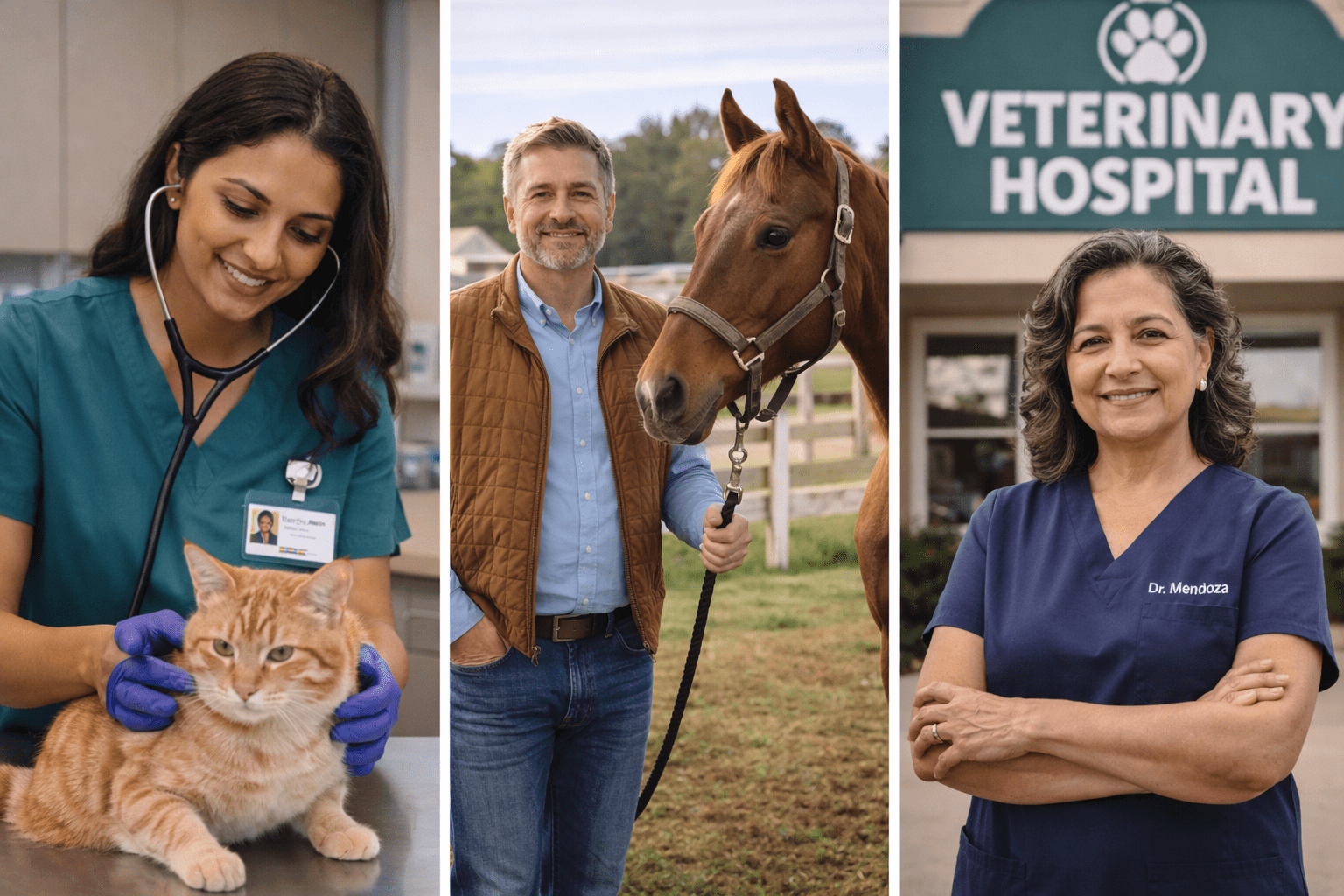
Your VMD or DVM degree qualifies you for the same physician mortgage benefits available to MDs, DOs, dentists, and pharmacists—100% financing, $0 PMI, manual underwriting that evaluates mixed-income structures and practice ownership, and flexible DTI treatment that’s especially critical given the 1.70x proportional debt burden veterinarians carry.
Whether you’re a new associate purchasing your first home, an equine practitioner looking for rural property with acreage, a veterinary specialist leveraging a post-residency contract, a practice owner navigating self-employment documentation, or an established veterinarian building an investment portfolio—this program provides financing matched to veterinary career realities.
Take action today:
Start your journey: Buy a House | Build a Wealth Plan | First-Time Buyers | Homeowners | Active Investors
Official Veterinary and Financial Resources:
American Veterinary Medical Association (AVMA) — Professional advocacy, career data, student debt statistics, and practice resources for veterinarians.
Association of American Veterinary Medical Colleges (AAVMC) — Veterinary education data, enrollment information, and graduate outcomes.
USDA Veterinary Medicine Loan Repayment Program (VMLRP) — Federal loan repayment for veterinarians serving in designated shortage areas.
Consumer Financial Protection Bureau (CFPB) — Federal homebuying education, mortgage tools, and borrower protection.
Stairway Mortgage Resources:
Loan Programs Overview — All financing options
All Loan Calculators — 90+ calculators
All Case Studies — 75+ real-world examples
Buy a House Journey — Step-by-step guidance
Build a Wealth Plan Journey — Wealth-building strategies
Current Rates — Today’s rates
Guides — Downloadable resources
Blog — Latest articles
Need local expertise? Get introduced to trusted partners experienced with veterinary professional homebuyers.