

You earned the Doctor of Podiatric Medicine (DPM) degree through four years of undergraduate study followed by four years of podiatric medical school combining anatomy, physiology, pharmacology, biomechanics, lower extremity surgery, and clinical rotations—then completed three years of surgical residency training in hospitals alongside MD and DO surgical residents. You hold full prescribing authority, surgical privileges, hospital staff membership, and DEA registration.
Your career generates $150,000-350,000+ annually across settings including private surgical practice, group practice, hospital employment, wound care centers, orthopedic groups, sports medicine practices, and academic positions. DPMs perform reconstructive foot and ankle surgery, diabetic limb salvage, trauma repair, elective bunion and hammertoe correction, and complex revision procedures—surgical care generating the same insurance reimbursements as orthopedic surgeons treating the same anatomical regions.
Yet podiatric physicians encounter a qualification barrier no other medical professional faces: the bank recognition gap.
Loan officers unfamiliar with podiatric medicine may not recognize “DPM” as a qualifying medical credential. They may not understand that podiatric surgeons complete hospital-based residency training, hold surgical privileges, and generate income comparable to many MD/DO surgical specialties. This unfamiliarity—not your creditworthiness—creates unnecessary friction.
The Non-Conforming Loan for Medical Professionals offered through Stairway Mortgage, Division of NEXA Mortgage LLC, explicitly includes DPM among its qualifying designations. Every program benefit is identical to MD and DO physicians: up to 100% financing, no PMI, loan amounts to $2 million, manual underwriting, flexible DTI up to 50%, and multiple term options.
Use our Conventional Loan Calculator to see what a standard mortgage would cost—then understand why the DPM mortgage eliminates PMI and down payment barriers.
Key Details About the DPM Mortgage Program:
Ready to explore your podiatric physician mortgage options? Schedule a call with a loan advisor or take our Discovery Quiz to see which programs match your profile.

A DPM mortgage loan is the same specialized non-conforming mortgage available to MD physicians, DO physicians, dentists, pharmacists, and veterinarians—extended with identical terms to holders of the Doctor of Podiatric Medicine degree. The program recognizes that DPMs complete doctoral-level medical education, hospital-based surgical residency, and maintain the same clinical authority within their scope as other physician specialists.
Unlike conventional loans requiring 5-20% down with PMI below 80% LTV, or FHA loans carrying lifetime mortgage insurance, the DPM mortgage eliminates both.
How the DPM mortgage differs from standard physician programs at other lenders:
Some physician mortgage programs at other institutions do not include DPM. Loan officers may need to verify internally whether “Doctor of Podiatric Medicine” qualifies. The program through Stairway Mortgage explicitly names DPM alongside MD, DO, DDS, DMD, PharmD, VMD, and CRNA—no ambiguity, no additional verification, no secondary treatment.
Explore the Buy a House Journey for step-by-step guidance, or compare all options across our loan programs.
This section addresses the most DPM-specific qualification challenge: loan officers and automated systems that do not recognize the financial profile of podiatric physicians. This is not a credential deficiency—it is a bank knowledge gap that creates unnecessary barriers.
The recognition problem has three dimensions:
How the physician mortgage through Stairway Mortgage eliminates this gap:
The American Podiatric Medical Association (APMA) provides comprehensive information about podiatric medical education, training, and scope of practice for any party requiring verification.
Professional Credentials:
Qualifying designations (at least one borrower must hold one):
Career stage eligibility:
Co-borrower provisions:
Property and Transactions:
For investment properties: DSCR Loan | Calculator. For non-standard properties: Portfolio Loan. Estimate returns: Rental Property Calculator.
Income Documentation:
Hospital or group-employed DPM (W-2): W-2 and employment agreement. Base salary plus surgical bonuses, call pay, and production incentives averaged across two-year period.
Private practice DPM (self-employed): Two years tax returns. Surgical practice revenue and owner compensation through manual underwriting. Alternatives: Bank Statement Loan | Calculator and P&L Loan | Calculator.
Multi-setting DPM (mixed income): DPMs working at private practice plus hospital privileges plus wound care center. Manual underwriting aggregates all documented income streams. For 1099-heavy: 1099 Loan | Calculator.
Credit and Financial Standards:

Podiatric surgeons face a documentation challenge unique among qualifying professions: the gap between surgical production and insurance reimbursement creates income timing that conventional underwriting misinterprets.
The reimbursement timing problem:
Surgical production occurs on the date of service. A DPM performing a bunionectomy, ankle reconstruction, or diabetic wound debridement generates revenue on the surgical date.
Insurance reimbursement arrives 30-90+ days later. Commercial payers, Medicare, and Medicaid process claims on varying timelines. Complex surgical claims with multiple CPT codes may face initial denials requiring appeals, extending payment to 60-120 days.
Tax returns reflect reimbursement timing—not production value. A DPM who performs $400,000 in surgical production during Q4 may not receive full reimbursement until Q1 of the following year. December production appears on next year’s tax return—creating income that shifts between tax years.
How this affects mortgage qualification:
How manual underwriting addresses reimbursement timing:
For practices where reimbursement timing significantly distorts income documentation:
Bank Statement Loan captures deposits as they arrive—regardless of when the surgery was performed. The Bank Statement Loan Calculator can model your deposit-based qualification.
P&L Loan uses CPA-prepared current-period statements reflecting actual practice cash flow. Calculate: P&L Loan Calculator.
See documentation examples: Bank Statement Loan: Restaurant Owner Buys Using Deposits | P&L Loan: E-Commerce Owner Buys Using Profit Statements | 1099 Loan Purchase: IT Consultant Buys Investment Property.
Scenario: 30-year-old DPM completing PGY-3 surgical residency:
Solution: Employment contract at $225,000 qualifies—transforming purchasing power from $220,000 (stipend) to $500,000+ (contract). $0 IDR for DTI. $0 down. See Medical Resident and Fellow Home Loan Program for training-stage details. Use the Conventional Loan Calculator to compare.
Scenario: 34-year-old DPM, solo surgical practice, three years established:
Solution: Manual underwriting evaluates practice and equipment as business investment. IBR at $680 for DTI (not $2,100 under conventional rules). Tax returns document income. Alternative: Bank Statement Loan | Calculator if tax deductions reduce reported income.
Scenario: 37-year-old DPM employed by hospital system:
Solution: Manual underwriting captures full $242,000 including bonuses and call pay (not just $195,000 base). IBR at $620 for DTI. $0 down. No PMI saves $310/month.
Scenario: 42-year-old DPM partner in orthopedic/podiatry group:
Solution: Strong income supports qualification easily. For equity access on current home: Home Equity Loan | Calculator or HELOC | Calculator. Need to buy before selling? Bridge Loan | Calculator. Use the Jumbo Loan Calculator for higher-value purchases.
Scenario: 39-year-old DPM splitting time between private practice and hospital wound care center:
Solution: Manual underwriting aggregates both income streams. Mixed W-2/self-employment documented through tax returns and W-2. IBR at $580 for DTI. $0 down. No PMI saves $275/month.
Scenario: 48-year-old DPM, established practice, student loans paid:
Solution: Physician mortgage for primary residence. For investments: DSCR Loan | Calculator, Fix and Flip Loan | Calculator. Strategy tools: Rental Property Calculator | Investment Growth Calculator | BRRRR Method. Visit Build a Wealth Plan Journey.
See case studies: Home Equity Loan: Dentist Accesses Equity for Practice Expansion | DSCR Loan: Real Estate Agent Purchases Fourth Rental | Jumbo Construction Loan: Surgeon Builds Custom Estate | Conventional Loan: Physical Therapist Purchases First Home | DSCR Loan Refinance: Physician Improves Terms.
DPM graduates carry student loan debt averaging $180,000-250,000 from podiatric medical school. Combined with three years of surgical residency at $55,000-70,000 annually—during which meaningful savings is impossible—the financial profile at practice entry mirrors other surgical specialists but with a slightly lower initial income range than MD orthopedic or general surgeons.
Actual IBR/IDR payment used for DTI:
PSLF for podiatric physicians:
DPMs employed by non-profit hospitals, VA medical centers, academic institutions, and federally qualified health centers qualify for PSLF. Hospital-employed podiatric surgeons at non-profit systems are among the most common PSLF-qualifying DPM positions.
Strategic positioning: Enroll in IDR before applying. Obtain servicer documentation. Do not consolidate during mortgage application.

Yes—through Stairway Mortgage, completely identical. Same 100% LTV, $0 PMI, $2M limit, 50% DTI, manual underwriting. DPM is explicitly listed as a qualifying designation. Some other lenders may not include DPM—this program does, with no asterisks.
That won’t happen here. The program explicitly includes DPM. If you’ve experienced this elsewhere, it reflects that lender’s limitations—not a legitimate credential issue. The APMA and CPME provide verification if ever needed.
W-2 for employed DPMs. Tax returns for self-employed practice owners. Manual underwriting captures surgical bonuses, call pay, and production incentives. Production reports can supplement tax returns when insurance reimbursement timing distorts annual figures.
Yes. PGY-1 through PGY-3 residents qualify using stipend, co-borrower support, or signed post-residency contracts. See Medical Resident and Fellow Home Loan Program.
Manual underwriting evaluates production alongside collections. Production reports, accounts receivable documentation, and CPA letters explaining timing differences provide context beyond tax returns alone.
Two years tax returns. Alternatives: Bank Statement Loan | Calculator, P&L Loan | Calculator, Asset Based Loan | Calculator.
No—primary residence only. For investments: DSCR Loan | Calculator, Fix and Flip Loan | Calculator, Hard Money Loan | Calculator.
Rate-and-term refinance for primary residences. For cash-out: Home Equity Loan | Calculator, HELOC | Calculator. Visit Refinance or HELOC Journey.
Physician mortgage covers existing homes. For construction: Construction Loan | Calculator, Jumbo Construction Loan | Calculator, FHA Construction Loan | Calculator.
Yes. Non-podiatrist co-borrowers fully permitted. Spouse income combined. Non-occupant co-borrowers allowed with income capped at 50%.
30-45 days typical. Need faster? Same-Day Approval. Start: get pre-approved or submit a purchase inquiry.
For primary residence purchases:
For self-employed or complex income:
For investment and wealth building:
For equity access and refinance:
For construction and renovation:
Explore all loan programs | Browse all case studies | Run numbers with any loan calculator
Not sure which fits? Take our Discovery Quiz.
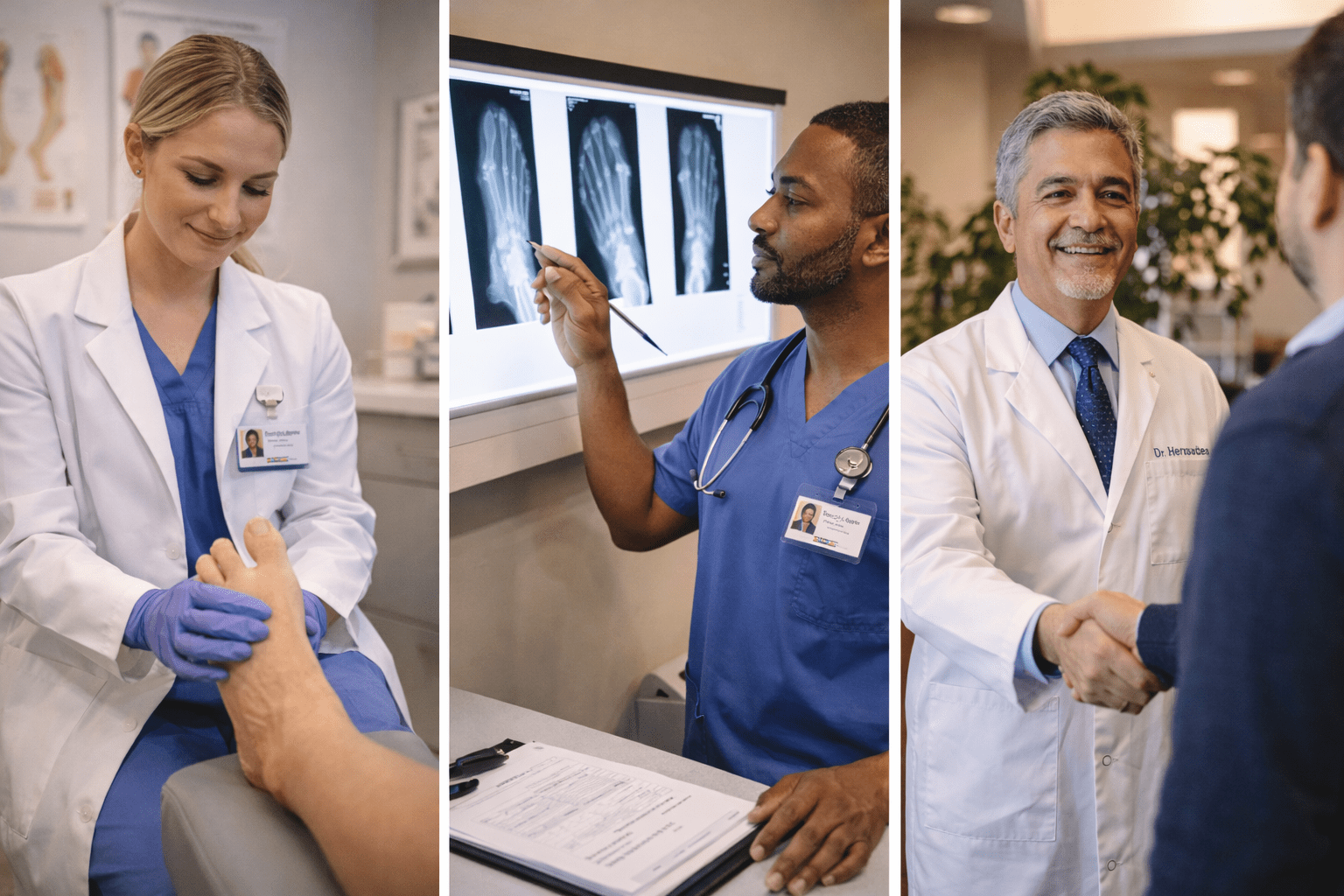
Your Doctor of Podiatric Medicine degree qualifies you for the same physician mortgage benefits available to MDs, DOs, dentists, pharmacists, and veterinarians—100% financing, $0 PMI, manual underwriting that recognizes podiatric surgical income, and the explicit DPM inclusion that eliminates the bank recognition gap. Whether you’re completing surgical residency with a signed employment contract, opening a private practice, growing a hospital-based surgical program, or building a multi-specialty podiatric and orthopedic group—this program provides financing matched to your surgical career.
Take action today:
Start your journey: Buy a House | Build a Wealth Plan | First-Time Buyers | Homeowners | Active Investors
Official Podiatric Medical and Financial Resources:
American Podiatric Medical Association (APMA) — Professional advocacy, practice resources, and public education about podiatric medicine and the DPM degree.
Council on Podiatric Medical Education (CPME) — Podiatric medical school and residency program accreditation ensuring institutional quality standards.
American Board of Foot and Ankle Surgery (ABFAS) — Board certification for podiatric surgeons demonstrating surgical competency and expertise.
Consumer Financial Protection Bureau (CFPB) — Federal homebuying education, mortgage tools, and borrower protection.
Stairway Mortgage Resources:
Loan Programs Overview — All financing options
All Loan Calculators — 90+ calculators
All Case Studies — 75+ real-world examples
Buy a House Journey — Step-by-step guidance
Build a Wealth Plan Journey — Wealth-building strategies
Current Rates — Today’s rates
Guides — Downloadable resources
Blog — Latest articles
Need local expertise? Get introduced to trusted partners experienced with podiatric physician homebuyers.